Worcester, MA · Garage Door Service
Garage Door Service for Worcester's Older Housing Stock
Worcester's housing runs 1938-1993 with a cold-severe climate that wears out torsion springs and tracks fast. See what fails, why, and what we carry on the truck.
- Repairs & new doors
- Springs & openers
- Serving 4 nearby communities
What Causes It Around Here
Most houses in Worcester's service area went up between 1938 and 1993, with the typical build year sitting around 1968. That matters because a door installed in a 1968 build still has 1968-era hardware bolted to it more often than not - steel brackets, single torsion springs rated for the lighter doors of that era, and track that's been painted over a few times. None of that was built to run forever, and 55 years of seasonal expansion and contraction has a way of finding the weak point.
Worcester also sits in a cold-severe climate band, and that's the other half of the story. Steel springs lose tension faster in repeated freeze-thaw cycles than most owners expect, and the grease in an old torsion unit thickens up hard below freezing, which puts extra load on the opener motor every time it tries to lift a door that isn't moving freely. Across the 55 named villages and towns we cover - from Shrewsbury five miles out to Marlborough fourteen miles out - the housing stock still runs mostly 1960s and 70s builds, so this isn't a one-street problem. It's the baseline condition of the whole area's garages once the thermometer drops.
How It Shows Up
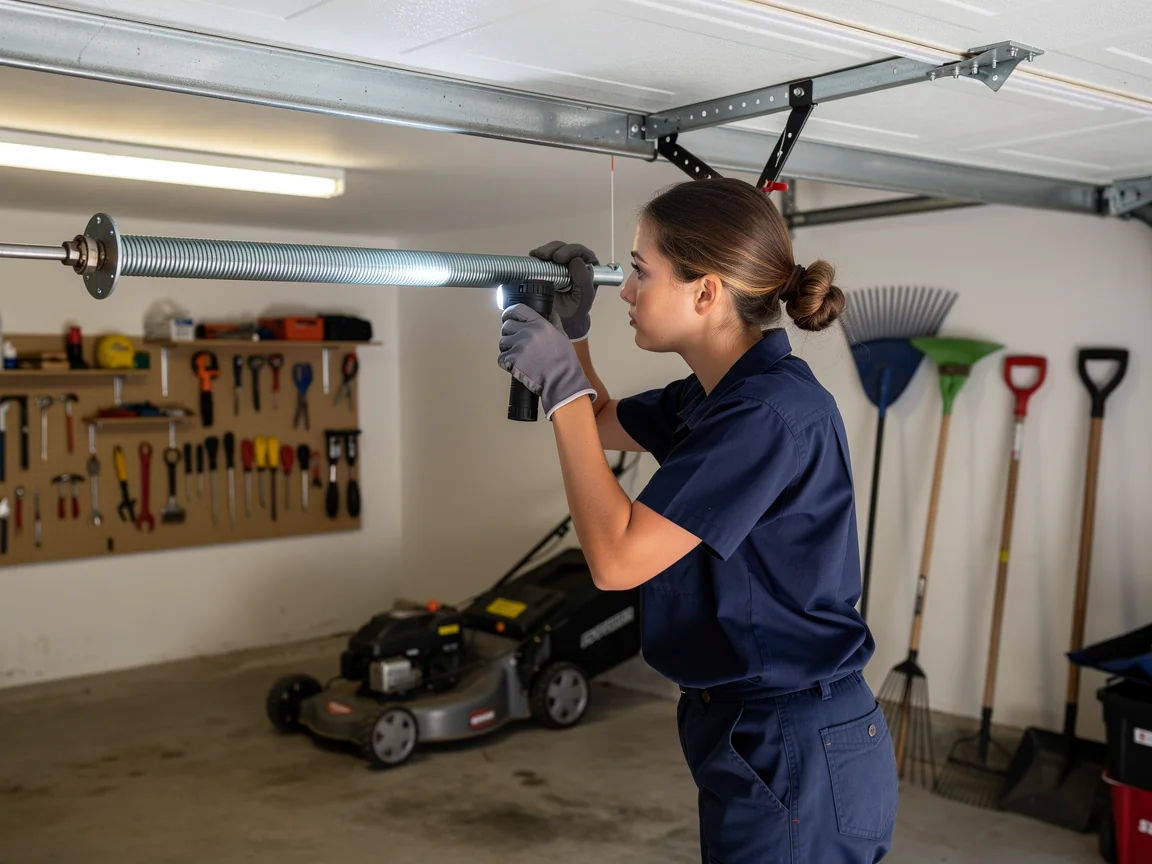
The first sign is usually noise - a bang, a grind, or a pop from the spring side of the door, often on the first cold morning after a warm stretch. That temperature swing is what finally snaps a spring that's been fatiguing quietly for years. After that you'll see the door hang unevenly, lift a few inches and stop, or come down faster than it should because the spring isn't carrying its share of the weight anymore.
Track misalignment shows up differently: a door that used to glide now drags or jumps near the top of its run, which on these older torsion setups is often frozen or dried-out lubricant rather than a bent rail. With 99,459 owner-occupied houses across the service area and a large share built before double springs became standard, a lot of garages here are running on a single spring doing the work two would do in a newer build - so when it goes, the door usually won't move at all rather than just slowing down.
What It Costs
We don't quote a number without seeing the door - spring size, cycle count, and whether the opener or sensors are also compromised all move the price, and guessing low over the phone just sets up a bad surprise later. What we can tell you is how owners here tend to decide. At a median household income of $113,402, most people in this area choose the repair that actually holds rather than a patch that buys six months, once a tech lays out what's actually worn versus what's just old.
One honest limitation: if the spring has failed on a door old enough that the drum, cable, and track are all original from a 1960s or 70s build, we'll tell you straight if replacement parts are hard to source or if the smarter move is a new door assembly instead of chasing parts for one that's outlived its design life. We'd rather say that up front than bill you for a repair that won't last the next cold snap.
Parts We Carry
Because so much of Worcester's garage stock dates to the 1938-1993 window, we keep torsion springs sized for both the older single-spring setups and the double-spring systems that came later, along with galvanized cable, nylon and steel rollers, and center and end bearings that fit the shaft diameters common on pre-1990s doors. We also stock weatherstripping and bottom seals rated for a cold-severe climate, since the vinyl on an original seal usually cracks and lets drafts in well before the door itself fails.
For openers, we carry logic boards, drive gears, and safety sensor kits that match the chain and belt-drive units installed across the area over the past few decades - not every brand, but the ones that actually show up on the trucks here. If your door needs a part we don't carry on the truck, we'll say so and tell you the lead time rather than stalling the job.
Frequently asked questions
Why did my garage door spring snap on a cold morning?
Steel loses some elasticity in cold weather, and a spring that's already fatigued from years of cycling will often go right at the point where temperature swings fastest - typically the first hard cold morning after a mild stretch. If your house dates to the 1960s or 70s, which is common across this area, the spring may simply be original.
Is it worth repairing an old torsion system or replacing the whole door?
It depends on what else is worn. If the track, drum, and bearings are all original to a 1960s-70s build and one part just failed, a straight repair often makes sense. If several parts are failing close together, we'll tell you when a new door assembly costs less over time than chasing parts one by one.
Do you carry parts for older doors on the truck?
Yes, for the torsion springs, cables, rollers, and bearings sized to the pre-1990s doors common in this area. Specialty opener boards or discontinued hardware sometimes need an order - we'll tell you up front if that's the case rather than guess.
Why does my door drag at the top instead of running smooth?
On older torsion setups this is usually lubricant that's thickened in cold weather rather than a bent track. It's a common complaint here given the cold-severe climate and the age of the hardware still in use across the area.
By Neighborhood
Garage Door Service across the Worcester area
We also handle garage door service in these Worcester-area suburbs.
Book garage door service in Worcester
Call now or request a quote - tell us what the door is doing and where you are.